
PATHWAYS
Energy & Emissions
South Sea Pearl farming depends on healthy marine ecosystems, & climate change continues to place pressure on the ocean environments that support oyster health & pearl production. At Atlas Pearls, we recognise that managing our energy use & greenhouse gas emissions is an important part of protecting the long-term resilience of our operations, & long-term health of the environments we operate within.
Our emissions profile reflects the nature of our business: remote marine farming, vessel-based activity, and operations in locations where access to grid electricity is often limited. While South Sea Pearl farming has a relatively low environmental footprint compared with many extractive industries, our operational focus includes fuel efficiency, practical reductions in diesel reliance and consistent performance tracking.
Atlas Pearls manages emissions by focusing on practical actions that reduce fuel use across operations. This includes improving vessel efficiency, optimising logistics, maintaining equipment, and strengthening site-level energy tracking. These efforts support responsible marine farming and improve visibility of the operational activities that contribute most to emissions across our sites. During FY26, energy efficiency initiatives at our Denpasar office also contributed to lower electricity consumption and associated emissions.
Pathways
Energy Use Across Our Operations
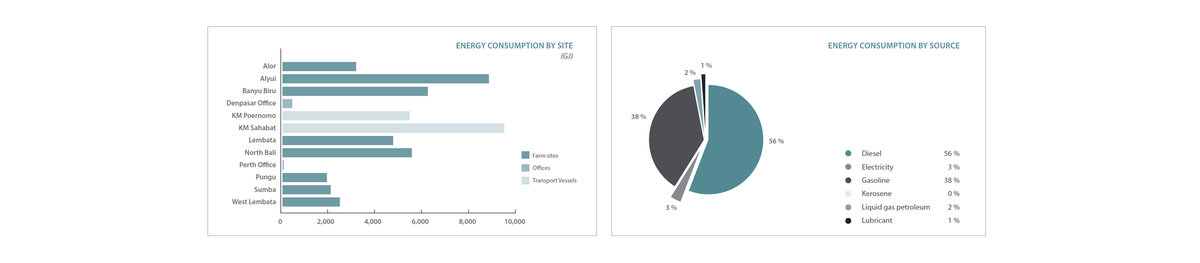
Our energy use is concentrated in two areas: marine operations and land-based support activities. Our fleet is essential for transporting people and materials, water based farming activities for oyster maintenance, supporting farm infrastructure, and connecting our remote sites. On land, energy is used for accommodation, workshops, processing support, refrigeration, communications and administration.
Energy requirements vary significantly between locations. Larger operational sites and logistics vessels naturally account for a greater share of total energy use, while smaller farms and offices have a more limited footprint.
Diesel and gasoline remain the primary energy sources across our operations, reflecting the remote geography of many of our sites and the limited availability of reliable grid infrastructure. Where electricity access is available, it contributes a smaller proportion of total energy consumption.
Energy tracking across sites supports informed decision-making by showing where diesel generation, vessel fuel use and electricity consumption are concentrated. This helps identify practical efficiency opportunities that are technically and operationally suitable for remote marine farming environments.
Pathways
Emissions Across Our Operations
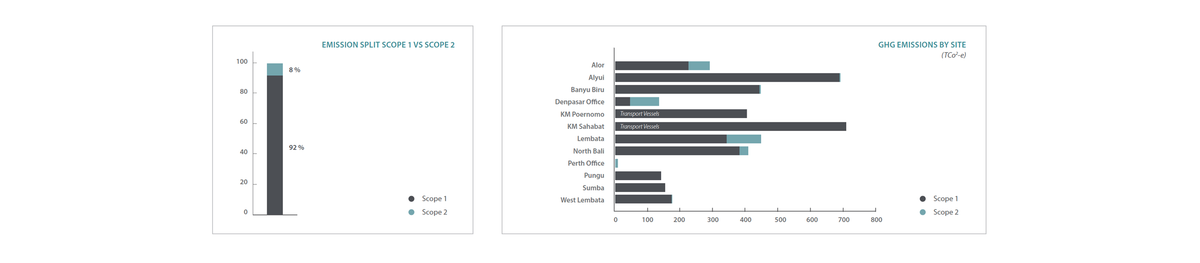
Our greenhouse gas emissions are closely linked to the fuels required to operate in remote coastal regions. Diesel-powered generators, vessels, water pumps, logistics activites and site accommodation all contribute to our Scope 1 emissions, which represent the majority of our combined Scope 1 and Scope 2 footprint.
Because many of our farms operate beyond reliable electricity grids, direct fuel use remains the largest contributor to our emissions profile. This makes fuel efficiency, logistics planning, equipment selection and renewable energy feasibility important parts of our emissions management approach.
The emissions-by-site profile reflects operational scale, vessel activity and the level of energy required to support farming and logistics at each location. Larger production sites and logistics vessels contribute a higher share of emissions, while smaller sites and offices represent a lower overall impact.
Atlas Pearls manages emissions by focusing on practical actions that reduce fuel use across operations. This includes improving vessel efficiency, optimising logistics, maintaining equipment, and strengthening site-level energy tracking. These efforts support responsible marine farming and improve visibility of the operational activities that contribute most to emissions across our sites.